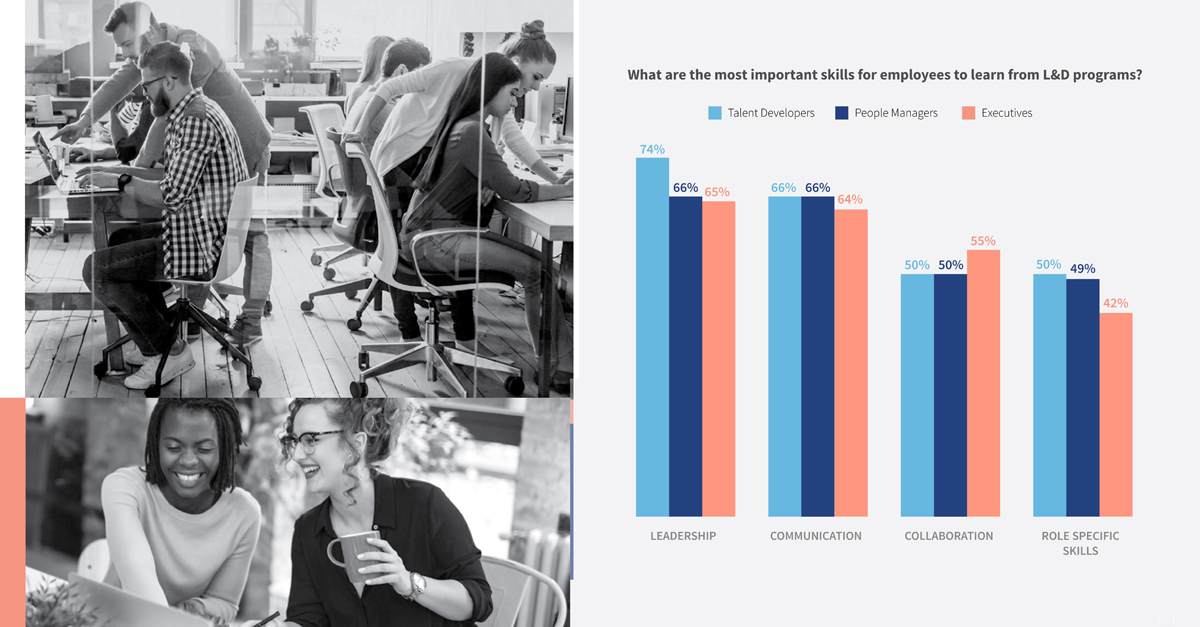
As automation reshapes more job functions, the skills that hold up best aren't necessarily technical ones, they're the human skills that are harder to automate: leadership, communication, collaboration, and role-specific judgment. Building these skills deliberately, rather than assuming they develop on their own, is one of the more effective ways organizations can soften the disruptive impact of automation on their workforce.
As routine, rules-based tasks increasingly move to automated systems, the remaining human work concentrates around judgment calls, relationship management, and problem-solving that don't follow a fixed script. Employees who haven't developed strong communication and collaboration skills are at a structural disadvantage in this shift, regardless of how strong their technical skills are.
This has a direct implication for workforce planning: technical upskilling alone doesn't fully prepare a team for an automated environment. Soft skills training needs to be part of the same strategy, not an afterthought.
Organizations that treat learning and development as a strategic function, not just a compliance requirement, tend to navigate automation-driven change more successfully. Effective L&D teams do more than deliver static training content; they identify emerging skills gaps before they become critical, build learning paths for a genuinely multi-generational workforce, and create a culture where continuous learning is expected rather than exceptional.
Generic, one-size-fits-all training tends to underperform. The strongest programs combine a few elements:
Programs built around Lean Six Sigma, data analytics, and applied business skills tend to land better than generic soft-skills seminars, because they combine the interpersonal training with a concrete, job-relevant application.
TDS Global Solutions provides custom learning and development programs that combine soft skills training with practical, job-relevant methodologies like Lean Six Sigma and data analytics.
Want to prepare your workforce for the next wave of automation? Schedule a call with TDS Global Solutions.