
Nearshore software development means working with a development team in a nearby country, usually with enough working-hour overlap for regular collaboration. For a business building or maintaining software, that can make planning, code reviews, and release decisions easier to coordinate across company boundaries.
Proximity alone does not tell you whether a provider can deliver. The more useful questions are who will do the work, how responsibilities will be divided, and what evidence shows that the team can maintain your product. This guide explains the engagement models, costs, locations, and checks that help you choose the right team.
Nearshore software development is an outsourcing arrangement in which a company works with developers in a geographically nearby country. For a US business, this often means evaluating teams in Latin America. The intended benefit is workable overlap between the client’s and provider’s business hours, alongside access to engineering skills.
There is no universal time-zone threshold that makes a team nearshore. Check the actual cities, contracted working hours, daylight-saving changes, and holiday calendars. A team that is geographically close may still provide less overlap than your delivery process needs.
Onshore development uses a provider in your own country. It may simplify in-person collaboration and some administrative arrangements, but location does not guarantee a shared working schedule or strong technical delivery. Nearshore expands your provider options across nearby borders. Compare both using the same scope, seniority, responsibilities, and acceptance criteria.
Offshore development typically involves a more distant location and potentially a larger time difference. That can suit work with clear specifications and mature asynchronous handoffs. Nearshore can be useful when requirements evolve through discussion, engineers need quick access to product owners, or releases require joint decisions. Our nearshore and offshore comparison explains the broader operating tradeoffs.
Consider nearshore delivery when your main constraint is access to suitable engineering capacity and your internal team can support the partnership. The arrangement is particularly worth evaluating when:
Nearshore is less likely to solve a project whose priorities keep changing without an accountable product owner. It also does not remove architectural debt or substitute for clear requirements. Resolve those constraints, or explicitly include discovery and technical assessment in the engagement.
Define the work you need before asking providers for rates. A proposal for individual developers is not equivalent to a service that includes technical leadership, testing, and release responsibility.
Teams can build customer-facing products, internal platforms, APIs, and integrations. Ask which parts of the lifecycle are included: discovery, architecture, implementation, documentation, testing, deployment, and maintenance. For existing software, provide enough technical context to assess integration and migration effort.
Nearshore mobile teams may work on native or cross-platform apps. Evaluate experience with your required platforms, accessibility needs, device testing, backend integrations, and release process. A credible schedule depends on scope and dependencies; a generic promise to take any app from prototype to production in a fixed number of weeks is not a planning baseline.
Testing can be a separate engagement or part of the development team. Specify the balance of exploratory testing, automated regression tests, performance testing, and security testing. Agree who fixes defects, who approves releases, and which test evidence you receive.
These services may cover deployment pipelines, infrastructure configuration, monitoring, incident support, or ongoing product improvements. Define production access, on-call coverage, escalation times, and ownership of infrastructure changes. Shared working hours do not automatically include after-hours incident response.
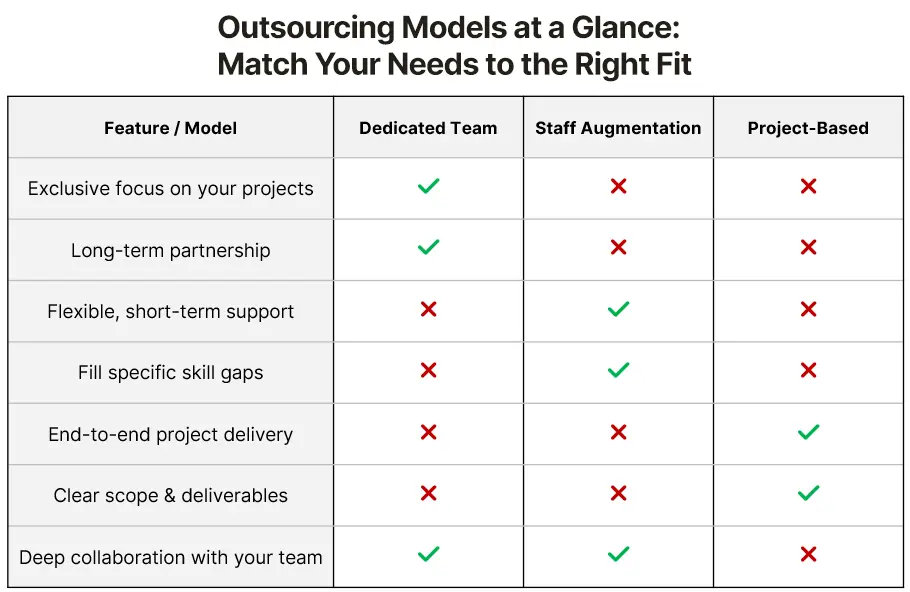
A dedicated team provides ongoing capacity for a product or program. It can include developers, a technical lead, quality assurance, and delivery management, depending on the agreement. This model suits a continuing roadmap, but it does not automatically transfer product strategy to the provider. Identify who prioritizes the backlog and approves completed work.
Staff augmentation adds individual specialists to your existing team. Your organization usually retains day-to-day task management and technical direction. It works best when you already have engineering leadership and need additional capacity or a specific skill. Include your managers’ review and onboarding time in the cost comparison.
A project engagement gives the provider responsibility for agreed deliverables. It can suit a defined integration, application, or modernization phase. Specify acceptance tests, dependencies, change control, and what happens when assumptions prove incorrect. A fixed price is only meaningful when the scope and responsibility boundaries are sufficiently clear.
There is no reliable savings percentage that applies to every nearshore engagement. Rates vary with the proposed team’s seniority, technology stack, location, contract terms, and delivery responsibilities. A lower hourly rate can still produce a more expensive outcome if substantial rework or internal supervision is required.
Compare proposals against the same delivery assumptions and include:
For example, a proposal for three developers should not be compared directly with a proposal for three developers plus a lead and a tester. Ask each provider to price the same scope and explain the work your employees will still need to perform.
Shortlist providers against the problem you need to solve. Then meet the proposed delivery team, review relevant evidence, and agree how you will assess an initial engagement. A structured vendor selection process helps keep an appealing presentation from outweighing delivery fundamentals.
Use these five checks to compare providers consistently:
Ask references about situations that resemble yours: onboarding into an existing codebase, handling an unclear requirement, replacing a key engineer, or recovering from a missed milestone. A provider’s response to a difficult delivery problem is often more informative than a list of technologies.
Where appropriate, begin with a paid discovery phase or a bounded feature. Agree on the expected output, review process, access arrangements, and acceptance criteria. Assess code quality, communication, and handover quality before expanding the scope.
Discuss your scope, technical requirements, and preferred working model with TDS Global Solutions.
Compare ProvidersWorking with a nearshore software outsourcing team requires a shared delivery process. Put the following responsibilities in place before the first sprint:
Choose measures that reflect the engagement: accepted work, lead time, escaped defects, release reliability, or recovery from incidents. Establish a baseline before setting targets. These measures should reveal delivery problems and support improvement, rather than encourage a team to maximize ticket counts.
Assess the people who will join the project, not only the sales team. A technical discussion or collaborative review can show how they explain tradeoffs and ask questions. Confirm whether proposed engineers are available, how replacements are approved, and who pays for replacement onboarding.
Ask how the provider protects code, manages access, reviews changes, handles dependencies, and responds to vulnerabilities. The NIST Secure Software Development Framework offers a useful common vocabulary for discussing secure development practices throughout the software lifecycle. Use it to structure questions and request evidence appropriate to your project.
A certification can support due diligence, but check its scope and relevance to the proposed work. Agree on practical controls such as named accounts, least-privilege access, approved environments, and timely access removal.
Clarify ownership of deliverables, treatment of pre-existing components, third-party licenses, and repository access in the agreement. Arrange appropriate review of contractual and data-handling requirements. Ensure your organization can retrieve documentation, build instructions, infrastructure configuration, and the materials needed for a transition.
Country selection can narrow a search, but it should not replace provider assessment. Start with your required skills, working hours, and delivery model. Our guide to software development outsourcing locations provides a broader starting point.
For US companies considering Mexico, compare the proposed team’s city, working schedule, and travel arrangements with your own operating needs. Ask for relevant product and technology experience, a realistic staffing plan, and references from similar engagements. Do not assume every Mexican team offers the same overlap or hiring capacity.
Evaluate providers in Colombia and Brazil against the same technical and operating requirements. Confirm the actual delivery location, the team’s working language, and coverage during your decision-making hours. For a wider business perspective, see our guide to outsourcing to Colombia.
When comparing teams in Argentina or Chile, test relevant technical experience and verify the proposed overlap across the year. Ask how the provider handles staffing continuity, commercial adjustments, and release support. Country-level impressions should not substitute for a review of the team assigned to your product.
Include providers in Costa Rica or the Dominican Republic when their capabilities fit your scope. Check seniority, specialist availability, and business-continuity arrangements directly. National literacy, industry growth, or infrastructure statistics do not establish whether an individual provider can deliver your software reliably.
TDS Global Solutions helps businesses explore outsourcing options and connect with providers aligned with their requirements. For software development, the starting point is your product scope, technology needs, preferred engagement model, and internal capacity to manage delivery.
Explore TDS’s software outsourcing services to discuss development, testing, maintenance, and related needs. A useful provider shortlist should reflect the work you need done and the responsibilities you expect the partner to own.
The strongest nearshore partnership combines suitable engineering skills with a delivery process your business can support. Compare complete proposals, test the proposed team, and establish ownership and continuity before committing to scale. Geography can make collaboration easier; the working agreement and the team’s execution determine whether that advantage translates into useful software.
Bring your roadmap, capacity gaps, and delivery requirements. TDS can help you explore suitable outsourcing options.
Schedule a CallNearshore software development means working with developers in a nearby country. Companies often choose it for working-hour overlap and access to suitable engineering skills. The relevant comparison is the proposed team’s actual schedule and capabilities.
It is a team assigned to support your product or program on an ongoing basis. Its roles and management responsibilities depend on the agreement. Confirm whether technical leadership, testing, and delivery management are included.
It can be, but savings depend on the complete engagement. Compare equivalent roles and scope, then include onboarding, internal management, testing, tools, rework, and maintenance. A lower hourly rate alone does not establish lower delivery cost.
Use clear ownership, shared delivery tools, and agreed working-hour overlap. Maintain one backlog, define acceptance criteria, review working software, and track quality and delivery outcomes. Keep documentation current so the project does not depend on a single person.
Mexico can be a suitable option when the provider fits your technical and operating needs. Assess the specific team’s skills, availability, location, working hours, and references. Country choice alone is not enough to establish fit.
Yes, if the team has the relevant mobile development and delivery experience. Check platform expertise, backend integrations, device testing, accessibility, app release responsibilities, and ongoing maintenance. Schedule the project around its actual scope.
Ownership depends on the agreement and the components used. Clarify deliverable ownership, pre-existing materials, third-party licensing, and repository access before work begins. Include a practical handover process.
Start with a defined piece of work and explicit acceptance criteria. A discovery phase or bounded feature can help you assess technical judgment, collaboration, and delivery quality. Expand after the team demonstrates that it can meet your needs.
Tell us about your service needs, goals, and preferred locations. TDS Global Solutions will help you compare vetted outsourcing providers and identify the best-fit solution for your business.