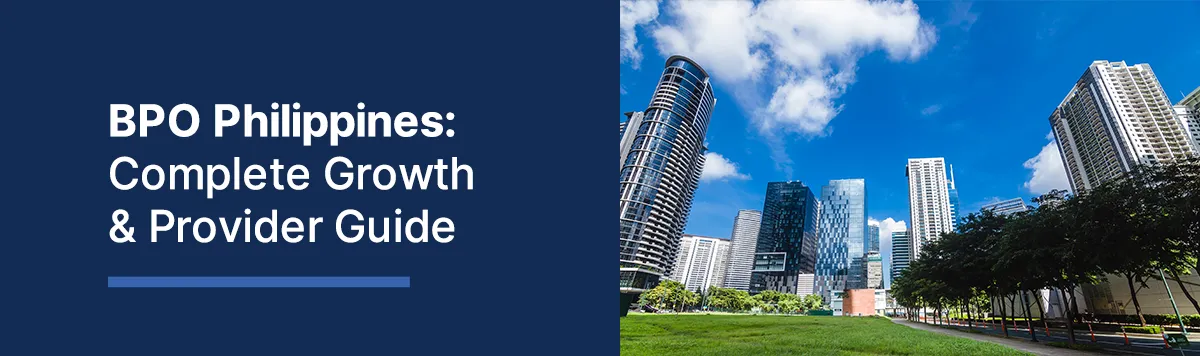
The Philippines is one of the most established destinations for business process outsourcing, especially for customer support, call center services, back-office support, healthcare support, finance and accounting, technical support, and sales support.
For companies looking to outsource, the Philippines remains attractive because of its large English-speaking talent pool, strong customer service culture, global outsourcing experience, and wide range of BPO providers across major cities such as Metro Manila, Cebu, Davao, Clark, Iloilo, and Bacolod.
But choosing a BPO provider in the Philippines should not be based on location alone.
The right partner depends on your service needs, customer expectations, budget, industry requirements, support channels, technology stack, quality standards, and long-term growth plans. A provider that works well for one company may not be the best fit for another.
This guide explains why companies outsource to the Philippines, common BPO services, top outsourcing cities, pricing factors, benefits, risks, trends, and how to choose the right Philippines BPO provider.
BPO in the Philippines refers to business process outsourcing services delivered by providers based in the Philippines.
These providers help companies manage business functions such as customer support, call center operations, back-office work, technical support, finance and accounting, healthcare support, appointment scheduling, sales support, and other outsourced services.
The Philippines BPO industry supports companies across many sectors, including:
Some companies outsource a single function, such as customer support. Others use Philippine BPO providers to build larger offshore teams that support multiple channels, departments, or regions.
For a broader overview of outsourcing to the country, see this guide on outsourcing to the Philippines.
The Philippines is not just a popular outsourcing location. It is one of the largest IT-BPM and BPO markets in the world.
In 2024, the Philippine IT-BPM sector reached approximately $38 billion in revenue, up 7% from $35.5 billion in 2023. The industry also reached about 1.82 million full-time employees after generating roughly 120,000 direct jobs during the year.
This scale is one reason global companies continue to consider the Philippines for customer support, call center services, back-office operations, healthcare support, finance support, and technical support.
At the same time, the industry is changing. Buyers are no longer looking only for low-cost call center seats. Many now want providers that can support automation, AI-assisted workflows, stronger reporting, higher-value roles, quality assurance, and specialized industry knowledge.
That makes provider selection more important. The best Philippines BPO partner is not simply the cheapest vendor. It is the provider that can match the business’s service needs, customer expectations, compliance requirements, technology stack, and long-term growth plans.
Companies often consider the Philippines when they need reliable support capacity, English-language service, cost control, and scalable operations.
Common reasons businesses outsource to the Philippines include:
The Philippines is especially strong for customer-facing support because many providers have long experience handling voice, email, chat, and omnichannel customer service programs.
For companies specifically evaluating call center support, Philippines call center outsourcing can help identify providers that match service goals, budget, and support requirements.
BPO providers in the Philippines can support a wide range of business functions. The best service mix depends on your industry, customer needs, and internal capacity.
Call center services are one of the most recognized BPO services in the Philippines.
These may include inbound customer service, outbound calls, sales support, technical support, appointment setting, surveys, and customer follow-up.
Philippine call center teams often support:
For companies comparing provider options, call center outsourcing can help evaluate service models, locations, pricing, and provider fit.
Customer support is one of the strongest use cases for outsourcing to the Philippines.
Businesses often use Philippine support teams to answer customer questions, resolve issues, manage tickets, support live chat, respond to emails, and provide phone support.
Common customer support tasks include:
For businesses that need support across multiple channels, Philippines customer service outsourcing can help compare providers with customer support experience.
Back-office outsourcing is another common BPO service in the Philippines.
These tasks are usually administrative, repetitive, or process-driven. They may not always be visible to customers, but they affect how smoothly the business operates.
Back-office services may include:
For companies with growing administrative workload, back-office outsourcing services can help reduce pressure on internal teams.
Some companies outsource finance and accounting support to the Philippines, especially for repeatable and process-driven tasks.
These services may include:
Finance-related outsourcing should be managed carefully because accuracy, access controls, documentation, and data security are important.
Healthcare organizations may outsource administrative and patient support tasks to Philippine BPO providers.
Healthcare BPO services may include:
Healthcare outsourcing should be reviewed carefully because privacy, patient communication, security, and compliance expectations are important.
For related guidance, see this article on healthcare outsourcing pros and cons.
The Philippines is also used for technical support and help desk operations.
Technical support teams may assist with:
Technical support usually requires deeper training than general customer service. Businesses should make sure providers can train agents properly and track quality across interactions.
Some Philippine BPO providers support sales-related functions such as outbound calling, appointment setting, lead qualification, and follow-up campaigns.
These services may include:
For sales-focused outsourcing, sales outsourcing services can help businesses compare providers with outbound and sales support capabilities.
The Philippines has several major outsourcing hubs. Each location has different strengths depending on talent depth, infrastructure, cost, provider availability, and business continuity needs.
Metro Manila, often referred to simply as Manila in global outsourcing conversations, is the largest and most established BPO hub in the Philippines.
It has the deepest provider market, the largest concentration of experienced agents, and strong access to supervisors, trainers, QA leaders, workforce managers, and specialized support talent.
Metro Manila is often a strong fit for:
The tradeoff is cost. Metro Manila is usually more expensive than provincial hubs, and competition for experienced BPO talent can be higher.
For companies evaluating the capital region, Manila call center outsourcing can help compare location-specific provider options.
Cebu is one of the strongest BPO hubs outside Metro Manila.
It is a good option for companies that want experienced outsourcing talent, strong English communication, and a more diversified location strategy outside the capital region.
Cebu is often a good fit for:
Cebu can be especially useful for companies that want a mature outsourcing location but do not want to rely only on Metro Manila.
Davao is a growing outsourcing location in Mindanao.
It may be attractive for companies looking for a cost-efficient support location, additional hiring markets, and geographic diversification.
Davao is often considered for:
Davao may not have the same provider density as Metro Manila or Cebu, but it can be a strong option for companies that want to expand beyond the most saturated BPO hubs.
Clark is a strong option for companies that value infrastructure, accessibility, and business continuity outside Metro Manila.
Clark sits within a major aviation and business zone. The Clark Civil Aviation Complex is located within Clark Freeport Zone and covers approximately 2,367 hectares, including aviation, logistics, and related facilities.
Clark is often a good fit for:
Its infrastructure and location make it useful for companies that want a Luzon-based alternative to Metro Manila.
Iloilo is a developing regional outsourcing hub with a strong education base.
The province has several state universities and colleges involved in local skills-development initiatives, including University of the Philippines Visayas, West Visayas State University, Iloilo Science and Technology University, Iloilo State University of Fisheries Science and Technology, and Northern Iloilo State University.
Iloilo is often a good fit for:
Its value is in the regional talent pipeline and lower saturation compared with the largest BPO hubs.
Bacolod is another regional outsourcing destination that can support companies looking for cost-conscious operations and additional talent pools outside the largest cities.
Bacolod is often considered for:
Bacolod may be a good fit for companies that want regional support capacity, but provider selection should be reviewed carefully because available services may vary by vendor.
Outsourcing to the Philippines can create several advantages when the right provider and operating model are selected.
The Philippines is widely known for English-language customer support.
This makes it attractive for companies serving customers in the United States, Canada, Australia, the United Kingdom, and other English-speaking markets.
Strong communication is especially important for customer service, technical support, sales support, healthcare support, and billing-related conversations.
Many Philippine BPO providers have long experience supporting global customers.
This experience can help businesses access agents, supervisors, trainers, QA teams, and operations leaders who understand contact center workflows.
Cost efficiency is one of the main reasons companies consider BPO providers in the Philippines.
However, businesses should avoid comparing providers only by headline hourly rate. The true cost depends on service type, location, staffing model, support hours, training requirements, technology, QA, management, and whether the quote is a base rate or a fully loaded rate.
As a rough planning benchmark, 2026 provider pricing guides often place fully loaded Philippine call center rates around $8–$18 per hour for English-language voice support. More specialized work, such as healthcare, finance, IT help desk, BFSI, or higher-complexity support, may run higher. One 2026 pricing guide places routine English voice at about $8–$12 per hour, senior English voice at $13–$18 per hour, routine non-voice and back-office work at about $8–$10 per hour, and specialized work around $14–$25+ per hour.
These ranges should be treated as estimates, not fixed market prices.
Actual costs can change based on:
Businesses should also ask whether the quote is a base rate or fully loaded rate. A base rate may exclude costs such as setup, QA, management, technology, facilities, and integration. A fully loaded rate is usually more useful for comparing providers because it reflects the broader operating cost.
The cheapest quote is not always the lowest-risk option. A higher-quality provider may cost more per hour but deliver better training, lower attrition, stronger QA, fewer escalations, and better customer outcomes.
For a deeper pricing breakdown, review this guide on call center outsourcing cost.
The Philippines offers access to a large outsourcing workforce across multiple cities.
This can help businesses scale support teams for growth, seasonal demand, new product launches, or expanded service coverage.
The Philippines is especially strong for voice-based customer service and call center operations.
This makes it a common choice for companies that need agents to handle inbound calls, outbound calls, appointment scheduling, account support, and customer service conversations.
Many Philippine BPO providers support more than phone calls.
They may also handle:
For companies building a broader support strategy, contact center services can help define the right channel mix.
Philippine BPO teams often support customers from Western markets, making the country attractive for companies that need service teams familiar with Western customer expectations.
This can be helpful for customer support, ecommerce, healthcare, financial services, and B2B support programs.
Outsourcing to the Philippines can be highly effective, but it still requires careful planning.
Not every provider is the right fit for every business.
A provider may be strong in customer support but weaker in technical support. Another may be good for enterprise programs but not ideal for smaller accounts.
The provider should match your industry, service complexity, budget, channel needs, and quality expectations.
Service quality can vary between providers, teams, programs, and locations.
Businesses should review:
For more guidance, review these call center quality assurance best practices.
Time zone differences can be helpful for after-hours or 24/7 support, but they must be planned properly.
Businesses should define:
Outsourced teams may need access to CRM, ticketing, billing, ecommerce, or internal systems.
Businesses should review:
This is especially important for healthcare, finance, insurance, and other sensitive industries.
Choosing the cheapest provider can create problems if quality, training, management, and reporting are weak.
A lower hourly rate may become expensive if customers receive poor service, issues are escalated incorrectly, or the internal team spends too much time fixing errors.
Outsourcing can fail when the provider does not receive enough training, documentation, or process clarity.
Before launch, businesses should prepare:
The Philippine outsourcing market continues to evolve as customer expectations, technology, and business needs change.
Customers now expect support across phone, email, chat, social media, messaging apps, and self-service channels.
Philippine BPO providers are increasingly expected to support connected service experiences rather than phone-only programs.
For related guidance, see omnichannel customer support.
Automation is changing how BPO teams manage repetitive work.
Examples include:
Automation should improve efficiency without replacing human judgment where empathy, problem-solving, or complex support is needed.
For more context, review customer support automation.
Companies are increasingly looking for providers with industry-specific experience.
This may include:
Specialization matters because training, compliance, workflows, and quality expectations vary by industry.
Businesses want more visibility into outsourced performance.
That means providers need to support:
Some companies prefer providers with multiple Philippine sites or multi-location strategies.
This can help reduce risk if one location is affected by weather, infrastructure issues, staffing limitations, or operational disruption.
Choosing the right BPO provider in the Philippines requires more than comparing price.
Start by defining what you need the provider to handle.
Ask:
Once your requirements are clear, compare providers based on fit.
Important provider selection criteria include:
For a deeper provider evaluation checklist, review these questions to ask a call center outsourcing provider.
Find the Right Philippines Outsourcing Partner
TDS Global Solutions helps businesses compare BPO providers in the Philippines across customer support, call center services, back-office support, pricing, service levels, and provider fit.
Explore Philippines Call Center OutsourcingBusinesses outsourcing to the Philippines may choose between shared, dedicated, or hybrid teams.
Shared agents support multiple clients. This can be useful for low-volume work, overflow support, after-hours answering, basic inquiries, or seasonal coverage.
Dedicated agents work primarily or exclusively for one client. This model is often better for complex support, higher volume, brand-sensitive work, technical support, regulated industries, and long-term outsourcing programs.
A hybrid model combines both. Dedicated agents may handle core support, while shared agents handle overflow, weekends, or after-hours demand.
For more guidance, see shared vs dedicated call center agents.
The Philippines is not the only outsourcing option. Businesses may also compare providers in Latin America, Eastern Europe, India, South Africa, Kenya, or other regions.
The right location depends on:
The Philippines is often strong for English-language customer support, voice operations, back-office support, and scalable offshore teams.
However, some companies may prefer nearshore locations when they need closer time zone alignment.
For a location comparison, see nearshore vs offshore outsourcing.
Outsourcing to the Philippines may make sense when:
It may not be the right fit if the work requires constant real-time collaboration with U.S. teams, highly specialized local knowledge, or workflows that are not yet documented.
Avoid these common mistakes:
The best results come from clear requirements, careful provider selection, strong onboarding, regular reporting, and ongoing performance management.
TDS Global Solutions helps businesses compare BPO providers in the Philippines and choose partners that fit their service needs, budget, industry, customer expectations, and growth goals.
Instead of searching for providers alone, companies can work with TDS to evaluate options across call center outsourcing, customer support, back-office support, healthcare support, finance support, technical support, sales support, and omnichannel service.
TDS can help businesses assess:
For companies that need deeper provider-selection support, BPO consulting can help with outsourcing strategy, vendor comparison, pricing review, service levels, implementation planning, and long-term performance tracking.
The Philippines remains one of the most important destinations for BPO and call center outsourcing.
Its strengths include English-language communication, customer service experience, scalable talent, cost-efficient support models, and a mature outsourcing ecosystem across several major cities.
But the location alone does not guarantee success. The provider, staffing model, training, QA, reporting, technology, and management process matter just as much.
Businesses should choose a Philippines BPO provider based on fit, not only price. The right partner should understand your industry, support channels, customer expectations, service levels, data security needs, and long-term goals.
If your business is considering outsourcing to the Philippines, contact TDS Global Solutions to compare provider options and find the right outsourcing partner.
Get Expert Help Choosing a BPO Provider in the Philippines
Whether you need customer support, call center services, back-office operations, or a dedicated offshore team, TDS can help you compare providers and choose the right-fit outsourcing solution.
Get a ProposalBPO in the Philippines refers to business process outsourcing services delivered by providers based in the Philippines. These services may include customer support, call center services, back-office support, technical support, healthcare support, finance support, and sales support.
Companies outsource to the Philippines because of its English-speaking talent pool, customer service experience, scalable workforce, cost-efficient support models, and established BPO provider ecosystem.
Common BPO services in the Philippines include customer service, inbound call support, outbound calls, email support, live chat, technical support, back-office processing, appointment setting, billing support, and data entry.
Top BPO cities in the Philippines include Metro Manila, Cebu, Davao, Clark, Iloilo, and Bacolod. The best city depends on provider availability, service needs, talent requirements, cost, and business continuity planning.
Yes. The Philippines is a strong destination for call center outsourcing, especially for English-language customer support, inbound calls, outbound support, appointment setting, technical support, and omnichannel service.
BPO costs in the Philippines vary by service type, provider, location, staffing model, complexity, and support hours. As a rough planning benchmark, fully loaded English-language voice support may fall around $8–$18 per hour, while specialized support can cost more. Actual pricing should be confirmed through provider quotes.
Risks include provider mismatch, quality inconsistency, weak onboarding, time zone planning issues, data security concerns, hidden costs, and choosing a provider based only on price.
Choose a provider by reviewing industry experience, service capabilities, training, QA, reporting, technology, security controls, scalability, pricing transparency, management structure, and fit with your customer experience goals.
Tell us about your service needs, goals, and preferred locations. TDS Global Solutions will help you compare vetted outsourcing providers and identify the best-fit solution for your business.